




BINTULU, East Malaysia. May 24, 2018. MABkargo, the air cargo arm of Malaysian Airlines, chartered a Silk Way West 747-400 freighter this week to fly nearly 72 tonnes of equipment from Leipzig, Germany via Baku Azerbaijan to Bintulu, Sarawak for the country’s integrated O&G company.
 “Oil & gas industry’s charters have always been very challenging and more often than not, present logistical intricacies,” explained MABkargo’s Sales & Marketing general manager Amiroel Shazrie Yussof.
“In this case, we had to prep a small airport to receive a big aircraft. With the support of a great ground handling team and local airport authorities, we made it happen today.”
Yussof said his company has gained invaluable experience over the years from coordinating and delivering O&G equipment as well as Grand Prix cars, concert equipment and livestock. “Our experience in handling charters [has] created a niche strength for us and has secured the trust of our customers. Today, charter flights are a key revenue generator for MABkargo,” he added.
Malaysia’s O&G company Petronas operates one of the world’s largest liquefied natural gas (LNG) production facilities in Bintulu with an annual production of 24 million tonnes per annum. The company has just begun selling its LNG output for the first time through GLX, an online trading platform of the world’s largest LNG buyers and sellers from Asia, Europe, North America, Middle East and Australia.
DHACA, Bangladesh: May 21, 2018. Austrian Transport minister Norbert Hofer and Shajahan Kamal, minister of Civil Aviation and Tourism for Bangladesh, have signed an aviation agreement to begin cargo and passenger flights between the two countries.
Three years ago, German low-cost airline Niki first suggested the idea as part of a codeshare plan with Etihad. "Direct flight connections are important in order to strengthen the economic development and cultural exchange of the two countries," noted Hofer.
 Earlier this month Austrian Airlines simultaneously celebrated 60 years of operations, resumed services to Tokyo from Vienna five times a week, and took delivery of another B777.
Meeting to celebrate the airline’s diamond jubilee, Austrian Federal chancellor Sebastian Kurz and Lufthansa Group CEO Carsten Spohr also agreed to expand Vienna as an airline hub.
“Air traffic develops particularly favourably at those flight hubs where all system partners - from the airlines and air traffic control to the airports and political decision makers - work particularly well together,” explained Spohr. “In addition to our important air traffic interfaces in Munich, Zurich and Frankfurt, we want to further enhance the profitability of Vienna and expand its role as a flight hub in European air traffic.”
According to Austrian Airlines, tourism contributes €4 billion or 1.4 percent to the country’s annual GDP and 50 percent of its exports by value are shipped as air cargo.
“Vienna’s role as an air traffic interface is essential for the Austrian economy,” said Kurtz. “For this reason, I pledged my full support to Lufthansa CEO Carsten Spohr in safeguarding the viability of Vienna Airport and expanding its role as a flight hub. In particular, we want to quickly implement the third runway project,” he added.
In a related move Lufthansa Cargo, formerly head by Spohr, has begun a twice weekly B777 freighter service from Frankfurt to Chengdu - adding to Shanghai, Beijing, Guangzhou and Hong Kong flights.
GENEVA: May 02, 2018. IATA says airfreight capacity rose faster than demand in March for the first time in 20 months. Demand rose 1.7 percent year-on-year, a drop of 5.0 percent over February, to produce the slowest growth in 22 months. The increase in global capacity fell to 4.4 percent from 6.3 percent in February.
As forecast last month, IATA says the slowdown is due to the end of an inventory restocking cycle coupled with a “softening” of global trade.
 “We would caution against reading too much into the softening in seasonally adjusted volumes in recent months as yet,” said IATA economist David Oxley. “We continue to expect freight-tonne kilometres to grow in the region of 4-5 percent in 2018. However, the bigger picture is that the recent period of airfreight outperformance looks to be firmly behind us.”
Airlines in all regions except Latin America reported year-on-year declines, with Africa falling 3.4 percent after reporting the fastest growth for 17 of the last 18 months; Asia-Pacific carriers produced growth of just 0.7 percent; European airlines’ traffic rose 1.0 percent as the € gain against the US$; Latin American airlines by comparison saw a 15.5 percent growth in volumes, in part due to an improved Brazilian economy; a growth of 0.8 percent by Middle East carriers in March was consistent with a “general weakening” over recent months; and North American airlines produced a 3.9 percent rise in traffic - although the US inventory-to-sales ratio rise in 2018 suggests an airfreight boost from restocking is over, says the Association.
"It’s normal that growth slows at the end of a restocking cycle. That clearly has happened. Looking ahead we remain optimistic that air cargo demand will grow by 4-5 percent this year,” added IATA director general and CEO Alexandre de Juniac.
“But there are obviously some headwinds,” he added. “Oil prices have risen strongly, and economic growth is patchy. The biggest damage could be political. The implementation of protectionist measures would be an own-goal for all involved—especially the US and China."
(Pictured: Qatar Airways inaugural to Cardiff, UK. The airline begins a daily B787 serivce from June 17 and will also add Doha - London Gatwick service this month.)
GENEVA: April 04, 2018. IATA member airlines report a 6.8 percent increase in air cargo demand in February 2018 compared to the same period last year. Adjusting for the Lunar New Year, this was the strongest start since 2015.
While demand outgrew a 5.6 percent rise in capacity during the month which helped maintain yields, IATA economist David Oxley warned the gap between supply and demand has begun to narrow.
 “It is worth noting that the new export orders component of the manufacturing PMI has softened in a number of key exporting countries in recent months, perhaps partly reflecting heightened concerns of a trade war,” he said.
“While the series generally remain above the notional 50-mark that is consistent with increasing demand for manufactured goods exports, order books in some countries – notably Germany, China, and the US – are no longer growing as quickly as they were a year ago,” he continued.
“Given that demand for airfreight tends to be the strongest at the start of economic and trade upturns, this further illustrates the gradual shift in the demand drivers away from the highly supportive levels that were in place throughout 2017.”
As a result, the seasonally-adjusted demand for air cargo which rose at a double-digit annualized rate for much of 2017 is now trending at 3.0 percent, Oxley added.
"The positive outlook for the rest of 2018, however, faces some potentially strong headwinds, including escalation of protectionist measures into a full-blown trade war. Prosperity grows when borders are open to people and to trade, and we are all held back when they are not," declared IATA director general and CEO Alexandre de Juniac.
During February, Asia-Pacific airlines saw air cargo demand grow 6.5 percent as capacity increased 7.2 percent; in North America, airline volumes rose 7.3 percent while capacity increased 4.1 percent; European airlines posted a 5.7 percent hike in traffic and a 3.8 percent rise in capacity; Middle Eastern carriers’ year-on-year freight volumes rose 7.4 percent while capacity increased 7.6 percent; Latin American airlines saw demand rise 8.7 percent as capacity rose 6.9 percent; and African carriers reported a 15.9 percent jump in demand as capacity increased just 3.9 percent.
DALLAS: March 15, 2018. IATA has launched DG Autocheck - a digital solution that allows air cargo supply chain stakeholders to ensure their shipments are in compliance with its Dangerous Goods Regulations (DGR).
An industry working group including Air France-KLM Cargo, Emirates airline, Qatar Airways, Swissport, Panalpina and DHL Express has helped develop the software service.
 The tool enables electronic consignment data to be received, processed and verified automatically using an XML message version of the DGR.
The AutoCheck enables ground handlers or airlines to accept or reject a shipment during the physical inspection stage by providing a pictorial representation of the package with its correct marking and labeling.
"The air transport industry handles in excess of 1.25 million dangerous goods shipments per year. With the air cargo growth forecast at 4.9 percent per year over the next five years this number will rise significantly,” said Nick Careen, IATA senior vice president Airport, Passenger, Cargo and Security.
“To ensure that air cargo is ready to benefit from this growth the industry needs to adopt modern and harmonized standards particularly in relation to dangerous goods,” he noted.
Currently every shipment declaration has to be checked against at least one of 3,000 entries in 1,100 pages of a paper version of the DGR.
"The air cargo supply chain is currently undergoing a major digital evolution. Collaboration across the industry is essential if the goal of a digitized electronic end-to-end messaging platform is to be realized. There is no time to lose; our customers already expect the efficiency of electronic documentation throughout the supply chain," added Careen.
SABETTA PORT, Russia: March 28, 2018. Volga-Dnepr Airlines has delivered 130 tonnes of industrial equipment on behalf of AeroTransCargo for the Yamal LNG gas recovery project.
 AeroTransCargo has already delivered over 3,500 tonnes of equipment using Volga-Dnepr IL-76TD-90VD and An-124 aircraft in temperatures as low as -35° Celsius.
“Our company is the contractor to one of the world’s largest oil and gas projects so it is essential for us to meet the terms of our responsibilities and provide continuous equipment supplies to the production site of the Yamal LNG plant,” commented director Alexander Supichenko.
Two flights delivered 70 and 60 tonnes respectively to Sabetta International Airport from Novy Urengoy in a 24-jour period. Volga-Dnepr has been servicing the project development since 2015.
Yamal LNG is owned and operated by a partnership of Novatek (50.1 percent), Total and CNPC (20 percent each) and the Silk Road Fund (9.9 percent) to tap natural gas reserves equivalent to over four billion barrels of oil.
Assuming no trade sanctions, each year nearly 16.5 million tonnes of LNG is expected to leave Sabetta to customers in Europe and Asia from the Russia’s South-Tambeyskoye gas field to European and Asian markets via the Northern Sea Route.
 DALLAS: March 14, 2018: Unisys has launched Digi-Pet, an IoT technology that provides pet owners with the ability to monitor and talk to their pets via personal devices including smartphones.
The new service is an addition to Unisys’ Digistics suite of digital solutions used by 20 of its airline customers that carry more than 180,000 animals annually.
Digi-Pet uses smart sensors attached to the pet’s kennel or carry case to monitor temperature, oxygen levels, vibration and light and transmit the data to owner and airline staff if something is wrong.
Pet owners can also subscribe to live video streaming, photos and voice exchanges so that they can see and talk to their pet via an app on their smart phone or tablet.
“We are emotionally attached to our pets and it can be distressing to be separated from them when traveling by air,” said Venkatesh Pazhyanur, Unisys senior industry director of Freight Solutions. He said the new service helps ensure all animals are carried safely by monitoring the pet’s condition from airport drop-off to airport arrival.
Commenting on the March 13 death of 10-month-old puppy 'Kokito' on a United Airlines aircraft after a flight attendant required the animal to be placed in an overhead bin, executive director of the U.S. Animal Legal Defense Fund Stephen Wells said: “As we mourn Kokito’s death, we urge United Airlines to truly take full responsibility by reviewing policy, retraining staff, and financially compensating the family for the full scope of their loss."
In addition to transporting cats and dogs, customers can also use Digi-Pet to ship horses, day-old chicks or hatching eggs, all of which require consistent heat, oxygen and light.
Watch: Talk to your pet
FRANKFURT SOUTH: March 26, 2018. German procurement company Trilatec has launched a 100 percent recycled paper-based pallet option called ‘squAIR-timber’ that it claims is 80 percent lighter than a wooden pallet.
According to Trilatec Technical director Stefan Trinkhaus, a one-meter pallet weighs only 1.2 kilos and can carry up to five tonnes if evenly distributed.
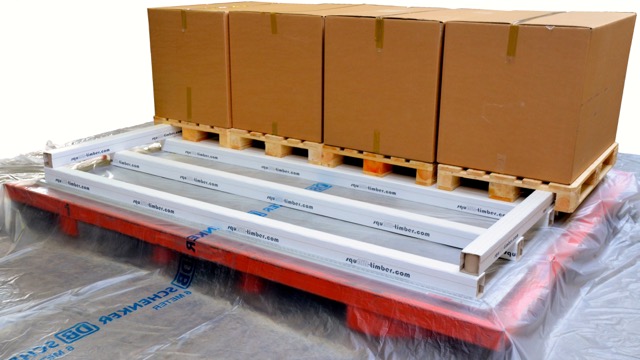 “The key to the stability lies in the manufacturing process,“ explained Trinkaus. “After working in cold glue combinations into several layers of the cardboard fibers these are laminated together under pressure. This process enables water resistance of the product, thus it is suitable for multiple use and at the same time ISPM15-compliant,” he added.
Last year Cargolux signed an agreement with Trinkaus for its squAIR-timber carboard fiber beams for use on pharma shipments out of Luxembourg.
“The use of modern, environmentally-conscious tools in air cargo underlines our standing as a green cargo carrier at a time when many of our customers put more emphasis on working with a partner who is aware of its responsibility towards the world we live in,” commented Cargolux EVP Global Logistics Lars Syberg. “In addition, Trinkaus provides us with products that make Cargolux more efficient and faster with the added advantage of lower costs. It’s an all-round winner for us.”
The airline says the use of squAIR-timber products has the potential to reduce its fuel consumption by 1,200 tons per year with subsequent lower CO2 emissions, enables shorter build-up times while eliminating the need for forklifts as the pallets can easily be handled by one person, and are 100 percent recyclable with lower disposal costs than wood-based equivalents.
Cargolux has begun a new weekly B747-8 service between Luxembourg and Narita, Japan in cooperation with Nippon Cargo Airlines. The flight leaves Luxembourg every Tuesday and returns via Incheon and Novosibirsk on a Thursday.
GENEVA: March 07, 2018. IATA reports air cargo demand rose 8.0 percent in January 2018 year-on-year, up from 5.8 percent in December, as freight capacity rose by 4.2 percent.
 The association says continued global demand for manufacturing exports is leading to longer supply chain delivery times and air cargo demand “may strengthen as a result”.
"With 8.0 percent growth in January, it’s been a solid start to 2018 for air cargo. That follows an exceptional year in which demand grew by 9.0 percent,” said IATA director general and CEO Alexandre de Juniac who added a warning: “If president Trump follows through on his promise to impose sanctions on aluminum and steel imports, there is a very real risk of a trade war. Nobody wins when protectionist measures escalate.”
As the Trump administration’s chief economic advisor announced his resignation on March 06, a spokeswoman today said she expected Trump to “sign something” by the end of the week. She didn’t say what.
With all regions reporting a January increase, Asia-Pacific airlines saw demand grow 7.7 percent; North American airlines’ volumes expanded 7.5 percent; European airlines posted a 10.5 percent gain; Middle Eastern carriers’ freight volumes increased 4.4 percent; Latin American airlines saw demand rise 8.0 percent and African carriers’ increased traffic by 12.9 percent year-on-year.
SHARJAH, UAE: March 20, 2018. RUS Aviation has reintroduced twice-weekly cargo services to Sulaymaniyah Airport (below) in Kurdistan northern Iraq.
 The move follows the lifting of an Iraqi government ban on international flights to Erbil and Sulaymaniyah earlier this month.
The Rus flight, with an A300 freighter, was the first commercial air cargo service to Sulaymaniyah after the reopening of the airport.
The company, which also operates the Il-76TD and B747 aircraft, said it would operate every Tuesday and Saturday from Sharjah.
Other regular destinations served by Rus from the UAE include Kyrgyzstan, Djibouti, Erbil, Bagram and Kabul.
Underwritten by the Iraq Ministry of Transport, an Airports Aviation Forum will be held within Baghdad International Airport on April 11-12.
The government has earmarked US$20 billion on airport development in the next few years with capacity expansion at Baghdad, Basra, Erbil, Najaf and Sulaymaniah and new airport construction in Karbala, Kirkuk, Diwania and Dohuk.
Commercial sponsors of the conference and exhibition include DHL and Bombardier.
 ROCKFORD, IL. February 21, 2018. The Chicago Rockford International Airport (RFD) has reported a 50 percent increase in landed cargo in 2017 to reach a record of nearly 627,000 tons.
The airport says the result is due to expanded operations by UPS, ABX and ATI over the year that also resulted in close to 2,300 new jobs.
"We are thrilled with the cargo results for 2017 and anticipate continued growth in cargo numbers for 2018," said Mike Dunn, RFD executive director. "Enhanced cargo operations have been instrumental in creating jobs and other economic opportunities. RFD board and administrative leadership are committed to continuing to attract and support businesses that ensure job growth in the region."
The airport also benefited from US$10.5 million in federal last year of which half has been allocated to expand the cargo apron to support three more 767-300 or two 747-8 freighters.
RFD says it expects to become a top 20 U.S. airport by cargo volume in the next two years. The airport is home to the second largest UPS hub in North America while ABX Air, ATI, and Atlas Air operate flights on behalf of Amazon's Prime Air operation. RFD is also served by two low-cost passenger airlines, Allegiant Air and Swift Air.


